Well here it is, September already, and actually the bushcraft adventures have continued, I have just not slowed down long enough to blog about them.
My good friend and brother in bushcraft, Shonuffisthemaster, continues to have some success in getting a regular attendance at his Saturday morning meet-ups at the Hyland Lake Park Reserve in Bloomington, MN.
A few Saturdays ago, I decided to leave my usual Saturday 9AM meet up at the Minneopa State Park, and head up to the twin cities to see just what kind of activity my friend had going on up there.
I met four very nice people on that day. Well, actually closer to 3.5. Let me explain.
In the morning, I met Appleshoe and her husband and their baby, Edric. (I think I got that right.) Anyway, we had a great time, with Shonuff' and I showing them the wonders of friction firecraft. After which, we all went out for a hike, looking for wild edibles and medicinal plants, before the afternoon session would get started at 1pm.
I really look forward to meeting them again. We all shared a great enthusiasm for the outdoors and learning and practicing primitive ways. As a family, they were very much involved in self reliance and sustainability and will bring much to our little group.
You can read a comment from Appleshoe posted in my previous blog article about "Backyard Bushcrafting."
Then in the afternoon, I met Donnie. Donnie demonstrated some very good skill with friction fire and cooking and other things. I hope he is able to meet more of the others, including some of the BushcraftUSA members, who have said they plan on coming out on some Saturday.
As Donnie and Sho' prepared for lunch, I decided to see just how long it would take to craft a wooden spoon out of some basswood that I had harvested while we were out on our hike. My goal was to finish it in the time it took to prep the fire, start the fire, prep the food and cook the food and then serve it up. I hoped it would be done by then.
I got to work on it and after a bit, with only my SAK Farmer and my Mora spoon knives to work with, I had this rough image of a spoon...
Within a few minutes after finishing the spoon, lunch was served and the spoon performed perfectly...
I was really glad to have my Mora spoon knife in my kit and I have decided that it will become part of my essential gear, for with it I can forge containers and those are hard to come by in the wilderness.
Flash forward a couple more weekends, and it is now Labor day. I had the privilege of getting out on a Saturday morning as usual and meeting with my friend and fellow bushcrafter, Sticker from BushcraftUSA. He and his family were spending a weekend in the same state park where we hold our meet-ups. So naturally I had to visit.
While I was there, I stumbled on a great piece of basswood that was just begging to be made into a spoon. I decided that I would try for something a little larger, maybe a soup spoon or a ladle and really try to sand and finish it up nice. Here is what the roughed out version looks for now.
This is still a work in progress and as of right now, I am slowly finishing the outside and am beginning to shape the bowl for just he thickness to allow good soup eating or ladeling.
I have to say, making a spoon is a great bushcraft project and it sharpens your knifecraft skills to allow you even more control when it comes to making other things.
I guess next I need to tackle the chicken stick. More on that later of course. Until next time, Happy Exploring.
On Discovering Self
"Walk in Peace... Learn from Nature... Find Yourself..."
Wednesday, September 18, 2013
Tuesday, August 27, 2013
On The Value Of Backyard Bushcraftin'
There is just something that is always adventurous when it comes to spending time with my bush buddy Christian. He is all of nine going on twenty and keeps me thinking young. He challenges me and helps me to see that bushcraft and being in the woods is all about being a kid.
We all know that kids don't have a lot of fun if they are uncomfortable or feel left out or are left alone with their own fears and doubts. So if being in the woods and having fun is like being a kid, and getting in some dirt time is also about being a kid, then it presumes that we are getting comfortable with the bush.
That is why I do not underestimate the power of the back yard when it comes to bushcraft. It is a taste of the familiar, with a mix of the wild and it works as a place to practice and walk thru the rite of passage into the wilderness. It just takes some imagination and most kids have it in spades.
A kid just gets really only one "first time" to sleep out under the stars, before he realizes that the next time he does, it won't be his first. It will just be another night, maybe special in its own right, but not like the first. So it was with that in mind, I decided to build a small fire pit in my backyard, line it with some rocks and sand and begin to setup a camp.
I was going to ready the camp for Christian's first night out under the stars and to spend some time with me bushcrafting, cooking, whittling and in general just having some boyish fun. I knew he was going to like it.
As I said, I started with making a fire pit, which looks something like this...
I had gotten the fire going with my bow drill set, as I figured it is the first fire in the pit I would start it with something special. Here is the bow drill set I used, a little basswood on basswood...
We all know that kids don't have a lot of fun if they are uncomfortable or feel left out or are left alone with their own fears and doubts. So if being in the woods and having fun is like being a kid, and getting in some dirt time is also about being a kid, then it presumes that we are getting comfortable with the bush.
That is why I do not underestimate the power of the back yard when it comes to bushcraft. It is a taste of the familiar, with a mix of the wild and it works as a place to practice and walk thru the rite of passage into the wilderness. It just takes some imagination and most kids have it in spades.
A kid just gets really only one "first time" to sleep out under the stars, before he realizes that the next time he does, it won't be his first. It will just be another night, maybe special in its own right, but not like the first. So it was with that in mind, I decided to build a small fire pit in my backyard, line it with some rocks and sand and begin to setup a camp.
I was going to ready the camp for Christian's first night out under the stars and to spend some time with me bushcrafting, cooking, whittling and in general just having some boyish fun. I knew he was going to like it.
As I said, I started with making a fire pit, which looks something like this...
I had gotten the fire going with my bow drill set, as I figured it is the first fire in the pit I would start it with something special. Here is the bow drill set I used, a little basswood on basswood...
Then I started on some water to heat up for a good cup of tea which seemed like a good idea...
I used my stainless steel "Little Jon" grill which was made by a good bushcraft friend of mind that knows his welding. Next I put together a pot hook and setup one half of a USGI canvas shelter or "pup" tent...
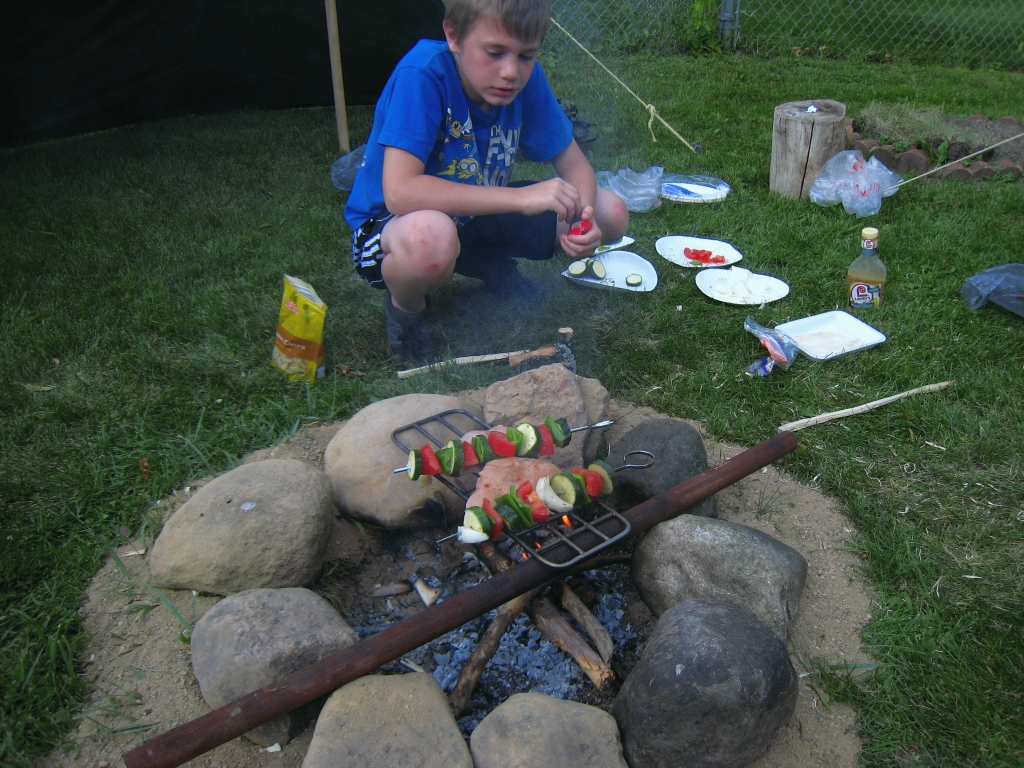
After making final arrangements to pick up my bush buddy, we went out for a hike along some local trails and then returned to the backyard to cook up some good food for supper. We made vegetable shish kabobs and chicken fillets...
The chicken was looking fine...
After a pleasant evening and eating and chatting and telling stories, we both settled into our open shelters for the night. The temperatures got down to about 53°F and there were very few mosquitoes.
My bush buddy tried to sleep in, but I got him roused and awake for breakfast. He seem to roll off of his mattress pad during the night and got a little cold, so I wrapped him up in my wool blanket...
We soon had the fire revived and hot water on to boil so we could make some cocoa and hot oatmeal for breakfast. He decided he wanted Campbells Double Noodle soup instead, go figure, but the pot hook worked great with the 10cm Zebra Billy can...
In the end, it was a great time and we grew closer together. I know this will be something we will do again and again and as he gains confidence, we will be able to make that transition to the woods and the wilds and who knows, someday he may just decide to make a solo trip of his own and begin to learn the things that I have learned and to feel the kinship with the landscape and to begin to feel at home with the wilderness wherever he may go. I want him to feel the things that I have felt and to someday, share those with his son. Then I know I will have done him right.
As the saying goes...
A USGI Shelter Half... $20
A 10cm Zebra Billy can... $30
Spending a night out under the stars with my son... priceless.
Until next time, Happy Exploring.
Monday, August 12, 2013
On Lessons In Knife Sharpening: The Mora Flat Scandi Grind
If you have followed my blog as of late, you will know that I have recently been attending a few meetups at the Hyland Lake Park Reserve in Bloomington, MN hosted by my good friend and brother in bushcraft, fellow BushcraftUSA member, Shonuffisthemaster.
I soon learned after a few meetings that Sho' has a particular knack for getting a scary sharp edge on his knives, and especially the beloved Mora.
The Mora knife has a wide and flat scandi grind that lends itself perfectly to being sharpened on a flat grinding stone, such as the Japanese water stones.
Eventually, Sho' and I talked about how he wanted to create a few videos that would cover the basic processes of sharpening knives, and that he wanted to start with the Mora and the scandi grind.
So on our last outing together, we started on making the first video in what I hope will be a series of very practical lessons on knife sharpening.
My good friend Sticker and I got together on that Sunday, to head up to the cities to spend some time at the park reserve and it was also the first time that Sticker and Sho' met.
As you can guess, most of the skills practice was about knife sharpening. We did get out for a hike and some wild edibles foraging and later did some practice with constructing some figure four deadfall traps.
Here is the video trip report and a shortened version of Sho's knife sharpening lesson, which is actually about 27 minutes long and can be found here, Knife Sharpening Lesson 1
I heard later from Sho' that another member of BushcraftUSA, that lives in or near the Twin Cities, had seen this posted video on the BushcraftUSA Trips and Expeditions section or Minnesota section and decided to join him and his friend on their recent Saturday get together. So I guess the videos are having a great effect on getting some members going out for some skills practice.
Well I hope you enjoyed the video and I look forward to sharing my next adventure with you all. Until next time, Happy Exploring.
I soon learned after a few meetings that Sho' has a particular knack for getting a scary sharp edge on his knives, and especially the beloved Mora.
The Mora knife has a wide and flat scandi grind that lends itself perfectly to being sharpened on a flat grinding stone, such as the Japanese water stones.
Eventually, Sho' and I talked about how he wanted to create a few videos that would cover the basic processes of sharpening knives, and that he wanted to start with the Mora and the scandi grind.
So on our last outing together, we started on making the first video in what I hope will be a series of very practical lessons on knife sharpening.
My good friend Sticker and I got together on that Sunday, to head up to the cities to spend some time at the park reserve and it was also the first time that Sticker and Sho' met.
As you can guess, most of the skills practice was about knife sharpening. We did get out for a hike and some wild edibles foraging and later did some practice with constructing some figure four deadfall traps.
Here is the video trip report and a shortened version of Sho's knife sharpening lesson, which is actually about 27 minutes long and can be found here, Knife Sharpening Lesson 1
I heard later from Sho' that another member of BushcraftUSA, that lives in or near the Twin Cities, had seen this posted video on the BushcraftUSA Trips and Expeditions section or Minnesota section and decided to join him and his friend on their recent Saturday get together. So I guess the videos are having a great effect on getting some members going out for some skills practice.
Well I hope you enjoyed the video and I look forward to sharing my next adventure with you all. Until next time, Happy Exploring.
Monday, August 5, 2013
A Simple Sheath For The SAK Farmer
It is not very often that I get the chance to blog about a project that really adds to the utilitarian nature of my kit, but recently I put together a knife sheath based on a design presented by IA Woodsman on the BushcraftUSA forum site. Here is a link to that post and the video of his DIY-SAK-Farmer-Pouch-Sheath .
I had acquired a long piece of a seat belt as a discard from a vehicular extraction training exercise that was held during our Fire School training weekend at the college where I work. So this project was a perfect way to use that webbing. It just seemed like I had all the right pieces, so I set to work on it.
Before sharing the photos of my finished project, I have to share that of all the knives I own, I seem to get the most our of my SAK Farmer. It is about the most used tool I have in my kit when I am out and about in the wilderness.
I am not saying this by any means as an outright endorsement or knife review per se, but simply stating that it is hard to go wrong if you choose a SAK Farmer for your bushcraft kit. I use the knife blade for all kinds of fire prep and carving needs and the saw blade for harvesting all manner of woods for various projects, and the awl is near perfect for drilling holes and using with my fire steel to get sparks and an ember going in my tinder bundle.
The SAK Farmer has been a long time friend for me in bushcrafting and for that reason it holds a special place in my kit. So it only seemed fitting to make a sheath for it to make it easier to get to and to add even more function combining it with a lanyard and fire steel for fire making.
I used the seat belt webbing for the main body of the sheath, one of the seven core strands of an eight foot piece of paracord for the whipping and stitching and a three sided sail cloth needle to push thru the three layers of material. Also the metal "D" ring was welded up and made by a friend of mine who used some O1 tool steel, because he was out of stainless, so now with the right piece of flint it throws a few sparks. The "D" ring will work perfect to hold the lanyard for my fire steel that will go in my pocket, while the knife sheath goes on my belt. What a nice addition to the mix.
Here are a few photos of how the project turned out.
The finished sheath...
The knife length for comparison...
Tucked away and a view of the belt loop...
The belt loop is just wide enough to accommodate a wider pack frame waist belt if needed or even a USGI canteen belt.
I think it turned out pretty good and as I understand it, this little project may be one of the next electives offered for the BushclassUSA classes. I guess that means I have the elective done now, I hope. Until next time, Happy Exploring.
I had acquired a long piece of a seat belt as a discard from a vehicular extraction training exercise that was held during our Fire School training weekend at the college where I work. So this project was a perfect way to use that webbing. It just seemed like I had all the right pieces, so I set to work on it.
Before sharing the photos of my finished project, I have to share that of all the knives I own, I seem to get the most our of my SAK Farmer. It is about the most used tool I have in my kit when I am out and about in the wilderness.
I am not saying this by any means as an outright endorsement or knife review per se, but simply stating that it is hard to go wrong if you choose a SAK Farmer for your bushcraft kit. I use the knife blade for all kinds of fire prep and carving needs and the saw blade for harvesting all manner of woods for various projects, and the awl is near perfect for drilling holes and using with my fire steel to get sparks and an ember going in my tinder bundle.
The SAK Farmer has been a long time friend for me in bushcrafting and for that reason it holds a special place in my kit. So it only seemed fitting to make a sheath for it to make it easier to get to and to add even more function combining it with a lanyard and fire steel for fire making.
I used the seat belt webbing for the main body of the sheath, one of the seven core strands of an eight foot piece of paracord for the whipping and stitching and a three sided sail cloth needle to push thru the three layers of material. Also the metal "D" ring was welded up and made by a friend of mine who used some O1 tool steel, because he was out of stainless, so now with the right piece of flint it throws a few sparks. The "D" ring will work perfect to hold the lanyard for my fire steel that will go in my pocket, while the knife sheath goes on my belt. What a nice addition to the mix.
Here are a few photos of how the project turned out.
The finished sheath...
The knife length for comparison...
Tucked away and a view of the belt loop...
The belt loop is just wide enough to accommodate a wider pack frame waist belt if needed or even a USGI canteen belt.
I think it turned out pretty good and as I understand it, this little project may be one of the next electives offered for the BushclassUSA classes. I guess that means I have the elective done now, I hope. Until next time, Happy Exploring.
Monday, July 22, 2013
Simple Time, Simplest Things, Simply Fun!
You know how there are times when you are out and about in your place of
wilderness, and you really have no particular bushcrafting kind of
skill thing in mind?
But you just want to have some fun anyway? So you follow your whims, make it up as you go along, try to invent something, improvise a tool or an item of use?
Well, that's what I did on this days outing. I think it was just one of those days.
I didn't have much time to spend on the trail, so I conjured up a simple item that allowed me to practice some natural cordage processing skills and to dust off some not so often used weaving skill.
Every time I go out exploring, I find myself looking for resources. Once you are familiar with things, everything you see takes on a whole new meaning.
Trees are just no longer for shade, they become sources for food, tinder, cordage, water, shelter, fire making materials, fuel for fire once its lit, landmarks, direction indicators, potential camp chairs and tables and poles for rigging tripods and making pot hooks. I think the list seems endless.
All manner of plants, both edible and non-edible (and the poisonous) become important for sustenance and materials for making things like cordage and spindles and tinder and for medicinal uses and the like.
Everything you see around you on the landscape takes on a new perspective as you find that kinship with it. And with the familiar, comes comfort and security, knowing that it will provide for you if you take care of things.
So it was on this particular day, I was looking at cattails. I have been spending lots of time with the cattail lately, learning what it has to offer in all its seasons.
I've eaten it's roots, stalks, pollen and the pollen making parts so it seemed only right to explore using the tall grassy part of the plant for something. I decided to weave myself a place mat.
I had found the reeds and some willow stalks nearby and sat down to the business of making up some cordage from the willow, so that I could tie together my "venetian blind" as it were.
Next I weaved some additional reeds into one end to reinforce it, so that anything heaving would not fall through.
Next I rolled up one end to for a "scoop-like" basket that could hold a few items.
Then it was time for testing it out, by collecting some very "sticky" sumac berries that are just starting to come into season and will be ripe for making into sumac-ade or "pink tea." It is a great summer time treat.
I was thankful that I did not have to use my bandana, as the berries were beginning to weep some of the sour juices that make it such a good choice for a beverage. Later, I used the scoop basket to collect some pencil lead sized twigs to use in my Emberlit stove.
It was a good time to just play around, and knowing the basics of weaving with reeds, gives you options for making even more containers and fish traps and the like. Weaving is an essential and often over looked bushcraft skill. I really need to play around with it some more.
I hope my friends that this will give you a quick idea on what you can try the next time you are out there and looking for something fun to do. I think it would make a good project to do with kids and the natural cordage processing is a very valuable skill to have for a lot of other things.
Until next time, Happy Exploring.
But you just want to have some fun anyway? So you follow your whims, make it up as you go along, try to invent something, improvise a tool or an item of use?
Well, that's what I did on this days outing. I think it was just one of those days.
I didn't have much time to spend on the trail, so I conjured up a simple item that allowed me to practice some natural cordage processing skills and to dust off some not so often used weaving skill.
Every time I go out exploring, I find myself looking for resources. Once you are familiar with things, everything you see takes on a whole new meaning.
Trees are just no longer for shade, they become sources for food, tinder, cordage, water, shelter, fire making materials, fuel for fire once its lit, landmarks, direction indicators, potential camp chairs and tables and poles for rigging tripods and making pot hooks. I think the list seems endless.
All manner of plants, both edible and non-edible (and the poisonous) become important for sustenance and materials for making things like cordage and spindles and tinder and for medicinal uses and the like.
Everything you see around you on the landscape takes on a new perspective as you find that kinship with it. And with the familiar, comes comfort and security, knowing that it will provide for you if you take care of things.
So it was on this particular day, I was looking at cattails. I have been spending lots of time with the cattail lately, learning what it has to offer in all its seasons.
I've eaten it's roots, stalks, pollen and the pollen making parts so it seemed only right to explore using the tall grassy part of the plant for something. I decided to weave myself a place mat.
I had found the reeds and some willow stalks nearby and sat down to the business of making up some cordage from the willow, so that I could tie together my "venetian blind" as it were.
Next I weaved some additional reeds into one end to reinforce it, so that anything heaving would not fall through.
Next I rolled up one end to for a "scoop-like" basket that could hold a few items.
Then it was time for testing it out, by collecting some very "sticky" sumac berries that are just starting to come into season and will be ripe for making into sumac-ade or "pink tea." It is a great summer time treat.
I was thankful that I did not have to use my bandana, as the berries were beginning to weep some of the sour juices that make it such a good choice for a beverage. Later, I used the scoop basket to collect some pencil lead sized twigs to use in my Emberlit stove.
It was a good time to just play around, and knowing the basics of weaving with reeds, gives you options for making even more containers and fish traps and the like. Weaving is an essential and often over looked bushcraft skill. I really need to play around with it some more.
I hope my friends that this will give you a quick idea on what you can try the next time you are out there and looking for something fun to do. I think it would make a good project to do with kids and the natural cordage processing is a very valuable skill to have for a lot of other things.
Until next time, Happy Exploring.
Thursday, July 18, 2013
On Sharing Bushcraft With Others
If you have been following along with my recent adventures, you will know that I have been visiting my new found brother in bushcraft and friend Shonuffisthemaster, for his hosted meet ups at the Hyland Lake Park Reserve in Bloomington, MN. As of July 14th, 2013, I think he has held six meetings so far and had three individuals show up on three of those meetings, not of course counting myself.
I feel his frustration. He told me at this last Sundays meetup that he has counted 18 BushcraftUSA members and other friends, who have expressed interest in coming to the weekly meetings, many who want to practice skills and get in some dirt time. Some say they want to come to introduce their family members to bushcraft and are looking for a good days adventure. Yet others want to start on bushclass lessons and pick up a simple skill here or there. For reasons unknown, few make the journey, even when he has offered to give them a ride.
I know that life can interfere sometimes with other things in life. Adventure comes more easily with convenience. Sometimes dirt time just has to take a back seat and so it goes with bushcraft.
It is within our human nature to take the easy way out, conserve energy, rest up when it is needed, taking the time to nurse the aches and pains of the previous days demands and to roll over and go back to sleep when the alarm goes off on Saturday morning reminding you that there is a bushcraft meetup at 9AM and you wanted to go for sure on Friday night, but the movie lasted way into the night and the dinner was heavy and now you just feel... well, sort of our of sync with it all.
I think of these things, as I am sitting in my car, in the parking lot, on a Saturday morning at 9AM, with the rain coming down, and the clouds getting blacker and thicker and the wind is blowing. I think of what it is that is in me, that drives me to get out of bed every single Saturday and get into my "greens" and load up my kit and go to the meet up point for a mornings and afternoons worth of dirt time. What drives me to do this? Am I insane? Do I really like bushcraft and the outdoors that much? And why isn't anybody else wanting to do what I do? Where are all the interested bushcrafters who talk about coming to practice skills and to get involved? Yes, I do feel his frustration, we are a rare breed indeed.
So when I arrived at the Sunday meet up, I was glad to hear from Sho' that a friend of his was going to be arriving for the afternoon session and that she was bringing her 4 year old son. She was interested in learning more about what bushcraft was all about. I knew we would be able to demonstrate several things for her, and help her to make her own bow drill set and try a few more things.
As it was, Sho' and I went out for our usual walk about and then later returned to the meet up point for more skills practice. Here is a list of the things we did throughout the day.
Morning Session and Hike -
•Cordage practice - square laying, parallel lashing
•Improvised simple compass with magnetized sewing needle
•Knife sharpening - mora
•Wild edibles ID - black raspberries, wild crab apples, wild grape ( non-ripe)
•Medicinal plant ID - white yarrow, plantain, willow inner bark
•Non- edible ID- bush honeysuckle, buckthorn, Virginia creeper
•Poisonous plant ID - poison ivy, virginia creeper
•Practiced animal tracking - studied dog tracks and measured and direction
•Sourced natural cordage material - willow bark, basswood, nettle
Afternoon Session with Guest and son -
•Bow drill fire - red cedar spindle and hearth, jute tinder, shavings
•Built fire for lunch with splitwood
•Knife Safety and assisted guest to build bowdrill set
•Hand drill with chemical assist- sugar and potassium permanganate
•Flint and steel - demo and assisted guest
•Practiced deadfall setup with promontory peg trigger
•Made a Digging Stick
•Cooked kabobs over fire
All the activities were fun as usual, but the highlights for me were making the improvised compass, as seen here in this picture,
and demonstrating the use of the hand drill for getting fire with a chemical assist of potassium permanganate and sugar.
It was a great day and in the end, I was glad for Sho' that he was able to have a friend come and enjoy the time he spent hosting a great meet up. I sure hope he is able to get more people to come. Maybe as word gets around and more trip reports are share, others will see how fun it is and want to come.
I know I have wished for the same thing for my little band of bushcrafters, if only they were as excited and passionate about bushcraft as my friend Shonuff and I are. Until next time, Happy Exploring.
I feel his frustration. He told me at this last Sundays meetup that he has counted 18 BushcraftUSA members and other friends, who have expressed interest in coming to the weekly meetings, many who want to practice skills and get in some dirt time. Some say they want to come to introduce their family members to bushcraft and are looking for a good days adventure. Yet others want to start on bushclass lessons and pick up a simple skill here or there. For reasons unknown, few make the journey, even when he has offered to give them a ride.
I know that life can interfere sometimes with other things in life. Adventure comes more easily with convenience. Sometimes dirt time just has to take a back seat and so it goes with bushcraft.
It is within our human nature to take the easy way out, conserve energy, rest up when it is needed, taking the time to nurse the aches and pains of the previous days demands and to roll over and go back to sleep when the alarm goes off on Saturday morning reminding you that there is a bushcraft meetup at 9AM and you wanted to go for sure on Friday night, but the movie lasted way into the night and the dinner was heavy and now you just feel... well, sort of our of sync with it all.
I think of these things, as I am sitting in my car, in the parking lot, on a Saturday morning at 9AM, with the rain coming down, and the clouds getting blacker and thicker and the wind is blowing. I think of what it is that is in me, that drives me to get out of bed every single Saturday and get into my "greens" and load up my kit and go to the meet up point for a mornings and afternoons worth of dirt time. What drives me to do this? Am I insane? Do I really like bushcraft and the outdoors that much? And why isn't anybody else wanting to do what I do? Where are all the interested bushcrafters who talk about coming to practice skills and to get involved? Yes, I do feel his frustration, we are a rare breed indeed.
So when I arrived at the Sunday meet up, I was glad to hear from Sho' that a friend of his was going to be arriving for the afternoon session and that she was bringing her 4 year old son. She was interested in learning more about what bushcraft was all about. I knew we would be able to demonstrate several things for her, and help her to make her own bow drill set and try a few more things.
As it was, Sho' and I went out for our usual walk about and then later returned to the meet up point for more skills practice. Here is a list of the things we did throughout the day.
Morning Session and Hike -
•Cordage practice - square laying, parallel lashing
•Improvised simple compass with magnetized sewing needle
•Knife sharpening - mora
•Wild edibles ID - black raspberries, wild crab apples, wild grape ( non-ripe)
•Medicinal plant ID - white yarrow, plantain, willow inner bark
•Non- edible ID- bush honeysuckle, buckthorn, Virginia creeper
•Poisonous plant ID - poison ivy, virginia creeper
•Practiced animal tracking - studied dog tracks and measured and direction
•Sourced natural cordage material - willow bark, basswood, nettle
Afternoon Session with Guest and son -
•Bow drill fire - red cedar spindle and hearth, jute tinder, shavings
•Built fire for lunch with splitwood
•Knife Safety and assisted guest to build bowdrill set
•Hand drill with chemical assist- sugar and potassium permanganate
•Flint and steel - demo and assisted guest
•Practiced deadfall setup with promontory peg trigger
•Made a Digging Stick
•Cooked kabobs over fire
All the activities were fun as usual, but the highlights for me were making the improvised compass, as seen here in this picture,
and demonstrating the use of the hand drill for getting fire with a chemical assist of potassium permanganate and sugar.
It was a great day and in the end, I was glad for Sho' that he was able to have a friend come and enjoy the time he spent hosting a great meet up. I sure hope he is able to get more people to come. Maybe as word gets around and more trip reports are share, others will see how fun it is and want to come.
I know I have wished for the same thing for my little band of bushcrafters, if only they were as excited and passionate about bushcraft as my friend Shonuff and I are. Until next time, Happy Exploring.
Friday, July 12, 2013
A Willow Hand Drill, A Box Elder Hearth Board And A Little Modern Chemistry
Although this is not your usual bushcraft idea for starting a fire, it does involve at first creating a hearth board with a good sized divot and a suitable sized hand drill that will roll easily between your hands and produce a little friction.
By adding to this fire making solution a little modern chemistry, you can get fire relatively easily.
Potassium Permanganate is the prime ingredient added to the hand drill and hearth board combination, along with some common sugar that might be part of any bushcraft or survival kit.
Potassium Permanganate is a controlled substance in some countries, I believe that Canada is one of them, but here in the United States it can be purchased in bulk at any Lowes, Home Depot or Menards store in the section where water treatment supplies are stored.
It is commonly used in the treatment of water as a de-ironing agent and for treating water in hot tubs, aquariums and pools and backyard ponds. It is used to combat algae growth and bacterial growth.
It is commonly found in larger first aid kits and when mixed in the right ratios can act as a wound wash, although there is a lot of information out now that says this should no longer be used and to seek alternatives.
Some people will have a small amount of potassium permanganate in their survival bag or kit, to use as a water purifier, wound wash and trace maker (if mixed in high enough concentrations it will write a message in the snow in purple).
Although there are several risks with any chemical, having an awareness of the possibilities of its use in the event of an emergency, can give you just one more thing to try, if you need to make fire.
So here is a video of my little experiment in mixing a little bushcraft with a little modern chemistry.
I do not always carry potassium permanganate in my kit, but having used it a few times over the years, it does give a good emergency option. I hope you enjoyed the video and thank you for watching. Until next time, Happy Exploring.
By adding to this fire making solution a little modern chemistry, you can get fire relatively easily.
Potassium Permanganate is the prime ingredient added to the hand drill and hearth board combination, along with some common sugar that might be part of any bushcraft or survival kit.
Potassium Permanganate is a controlled substance in some countries, I believe that Canada is one of them, but here in the United States it can be purchased in bulk at any Lowes, Home Depot or Menards store in the section where water treatment supplies are stored.
It is commonly used in the treatment of water as a de-ironing agent and for treating water in hot tubs, aquariums and pools and backyard ponds. It is used to combat algae growth and bacterial growth.
It is commonly found in larger first aid kits and when mixed in the right ratios can act as a wound wash, although there is a lot of information out now that says this should no longer be used and to seek alternatives.
Some people will have a small amount of potassium permanganate in their survival bag or kit, to use as a water purifier, wound wash and trace maker (if mixed in high enough concentrations it will write a message in the snow in purple).
Although there are several risks with any chemical, having an awareness of the possibilities of its use in the event of an emergency, can give you just one more thing to try, if you need to make fire.
So here is a video of my little experiment in mixing a little bushcraft with a little modern chemistry.
I do not always carry potassium permanganate in my kit, but having used it a few times over the years, it does give a good emergency option. I hope you enjoyed the video and thank you for watching. Until next time, Happy Exploring.
Subscribe to:
Posts (Atom)


